
★ Trusted since 2006Open 7 days a week, 7:00 AM–9:00 PM
★ Trusted since 2006Open 7 days a week, 7:00 AM–9:00 PM

★ Fireplace Repair
Fireplace Repair in South Florida
Cracked firebrick, a damper that will not move, a fireplace that smokes into the room. These are fixable, and they usually have a specific cause worth finding.
★ Overview
What fireplace repair actually involves
Fireplace repair covers everything from the hearth up to where the smoke chamber meets the flue. That is the firebox, the refractory mortar between the firebricks, the damper assembly, the throat, and the smoke chamber above it, the parts doing the hardest thermal work in the whole system.
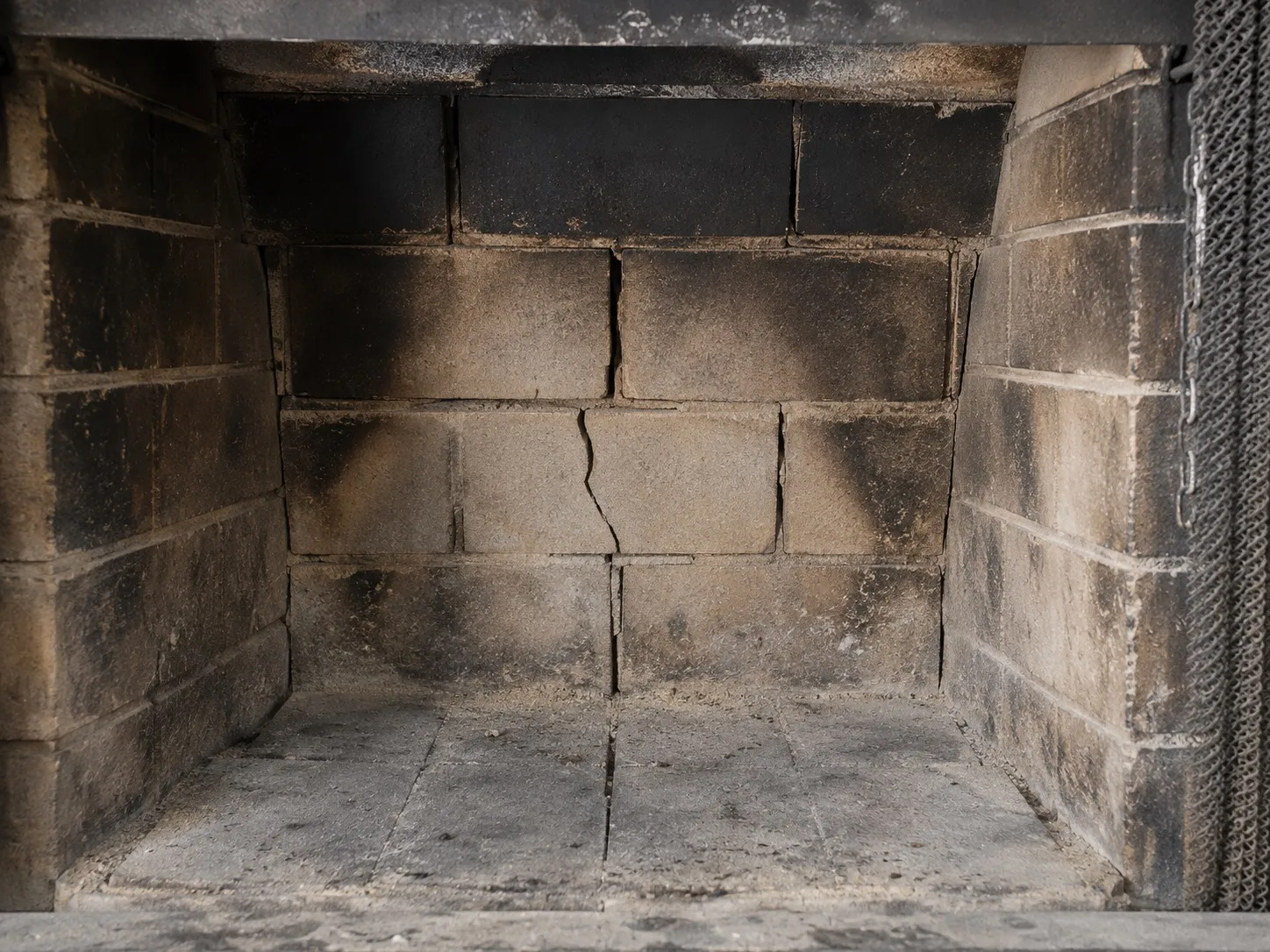
Firebrick and refractory mortar take direct flame contact and repeated heating and cooling. Joints open, brick cracks, and eventually there is a path from the firebox toward the framing behind it. A hairline crack in refractory mortar is routine maintenance. A gap you can put a fingernail into is not.
Smoking is the other common reason people call. It has several possible causes: an oversized fireplace opening relative to the flue, an unparged or badly formed smoke chamber, a blockage, a damper that is not opening fully, or negative pressure in a tightly sealed house. Guessing costs more than diagnosing, and we walk through all eight causes in why a fireplace smokes into the room.
★ Scope of work
What is included
Firebox repair
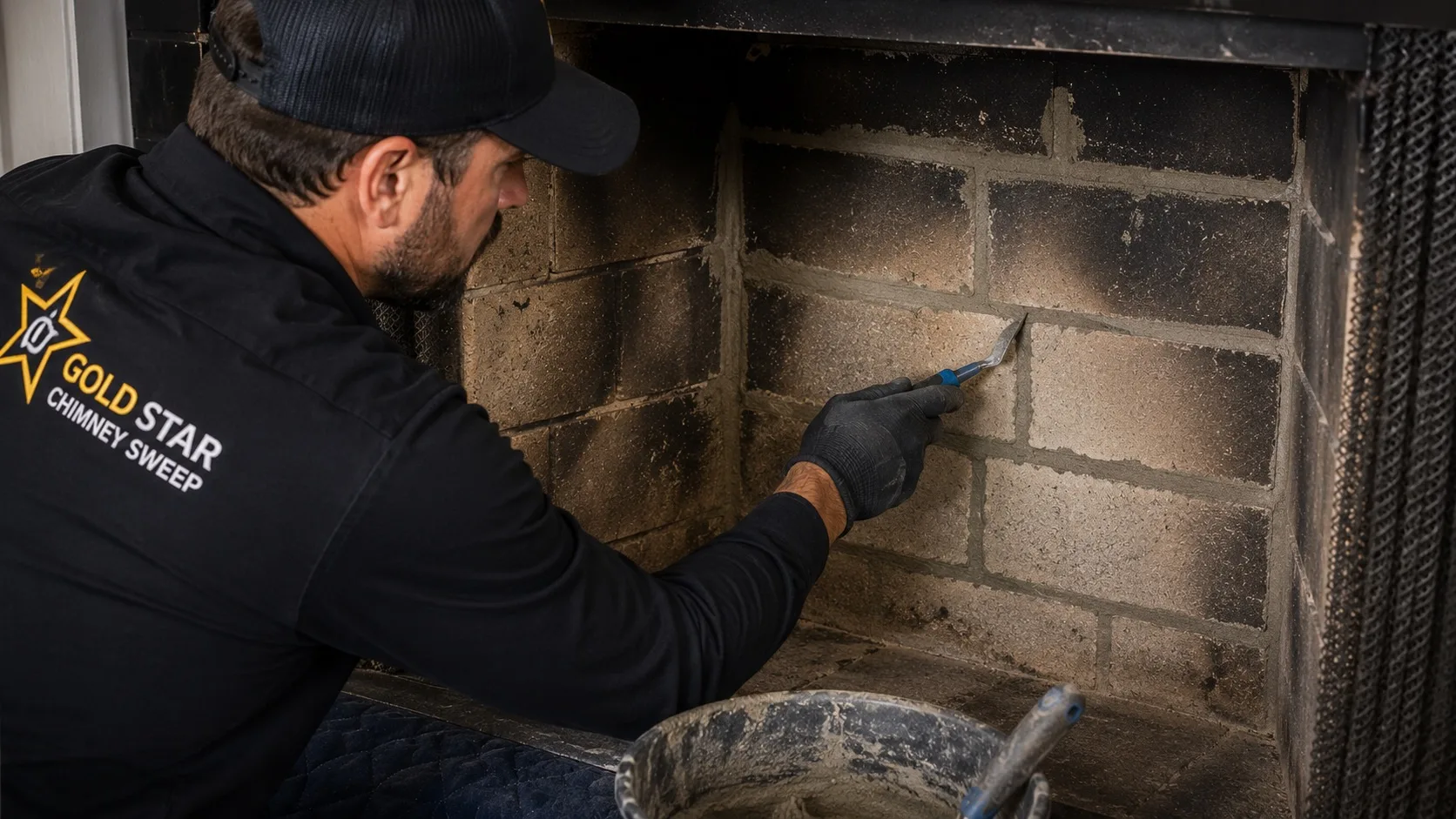
Cracked firebrick replaced and open refractory joints repointed with high-temperature mortar rated for the application.
Damper repair or replacement
Rusted, warped, and seized dampers repaired or swapped, including top-mount dampers that seal far better than throat dampers.
Smoke chamber parging
Corbelled smoke chambers smoothed and sealed with refractory mortar, which improves draft and closes gaps.
Draft diagnosis
Opening-to-flue ratio, damper travel, smoke chamber shape, and house pressure evaluated before anything is quoted.
Hearth and surround repair
Cracked hearth extensions and deteriorated surrounding masonry addressed.
Clearance evaluation
Whether combustible materials sit too close to the firebox, a genuine hazard that gets overlooked.
★ Warning signs
Signs you may need this
- Cracks or gaps in the firebrick or the mortar between bricks
- A damper that sticks, will not seal, or has rusted
- Smoke entering the room even with the damper fully open
- Crumbling mortar or loose brick inside the firebox
- A cold draft pouring out of the fireplace when it is not in use
- Rust, staining, or damp inside the firebox
Seeing more than one of these usually means the underlying issue has been developing for a while. It is worth having looked at rather than watched.
Why this is not worth deferring
The firebox is the last barrier between fire and the structure around it. Its walls are typically firebrick backed by ordinary masonry, and beyond that framing. Open joints let heat travel where it is not supposed to go, and the damage compounds every time you light a fire.
Beyond safety, most fireplace faults show up as a fireplace nobody uses. A stuck damper is a permanent hole in the building envelope. A smoky firebox drives people to stop lighting fires altogether. Both are usually straightforward to correct once the cause is properly identified.
★ South Florida
What goes wrong with fireplaces in South Florida
A fireplace that sits unused for most of the year develops a different set of faults than one in daily winter service.
Dampers that seize
This is the most common call we get here. A damper spends ten months in humid, often salt-laden air, and the assembly corrodes in place. Sometimes it will not open. More often it will not close, which quietly vents your conditioned air up the chimney all summer.
Tight houses and negative pressure
Homes here are sealed for air conditioning. Run a range hood, a dryer, and a couple of bathroom fans, and the house wants replacement air from somewhere. The chimney is often the easiest opening available, so air comes down the flue and brings smoke with it. It reads as a chimney fault and is not one.
Long idle periods
Refractory mortar and firebrick that go unused for months still take on moisture. The first fire of the season drives that moisture out fast, and rapid heating on a damp firebox opens joints that looked fine in October.
Corrosion inside the firebox
Rust on the damper, the smoke shelf, or a prefab firebox is far more common here than in a dry climate. On a factory-built unit it is also a service-life question rather than a repair question, and worth establishing early.
Prefabricated units
Many fireplaces here are factory-built rather than masonry. They are repaired with listed replacement parts for that specific model, not with generic components, and once parts are no longer available a replacement insert may cost less than chasing repairs.
What gets burned
Yard trimmings and palm fronds are not firewood. They flare unpredictably, throw embers, and leave heavy residue. Firewood stored uncovered in this humidity also never really dries, and damp wood is the fastest way to load a flue with creosote.
★ Our process
How we handle it
STEP 01
Inspect the firebox and chamber
Firebrick, refractory joints, damper, throat, and smoke chamber, with the flue checked as part of the same visit.
STEP 02
Diagnose the actual fault
Especially for smoking fireplaces, where the cause is often not where people assume it is.
STEP 03
Explain the options
Where there is more than one route, repair versus replacement, throat damper versus top-mount, you hear both.
STEP 04
Complete the repair
With materials rated for the temperatures involved, then a verification burn where appropriate.
★ Why choose us
Why homeowners book this with Gold Star Chimney Sweep
- The inspection comes first, so the recommendation has evidence behind it
- Photos of what we found, included in the written report
- Plain explanations, no jargon you have to nod along to
- Containment and floor protection on every interior visit
- Work priced by scope, written out rather than quoted verbally
- We are comfortable telling you nothing needs doing
★ Questions
Fireplace Repair FAQs
More on the full FAQ page.
Common causes are a blocked or restricted flue, a damper not fully opening, a fireplace opening too large for the flue size, a poorly formed smoke chamber, insufficient chimney height, or a house under negative pressure. Diagnosis narrows it quickly; guessing rarely does.
Fine surface crazing is normal. Cracks wide enough to catch a fingernail, or joints where mortar has fallen out, are not. They let heat past the firebox and need repairing.
Usually. Throat dampers can often be repaired or replaced in place, and a top-mount damper installed at the flue opening is a common alternative that also seals the chimney far better when the fireplace is not in use.
Often, yes. Masonry fireplaces are built to last and the failures are typically in serviceable components: firebrick, refractory mortar, damper. Full rebuilds are the exception rather than the rule.
It is worth fixing sooner than most people think. An open damper is a permanent hole in the building envelope, and in this climate it pulls conditioned air out and humid air in year-round. Many throat dampers can be repaired; a top-mounted damper at the flue opening seals considerably better.
That is a negative pressure signature. The house is pulling air out faster than it can replace it, and the chimney becomes the intake. Cracking a nearby window during a fire will usually confirm it. The permanent fix is a dedicated combustion air supply.
It depends on the model and the age. If listed replacement parts are still available it is usually straightforward. When they are not, a new insert can be the cheaper route. We tell you which situation you are in rather than quoting repairs on a unit that has run out of parts.
★ Next step
Need fireplace repair?
Tell us what you are seeing and we will tell you whether fireplace repair is the right next step, or whether something else is.